
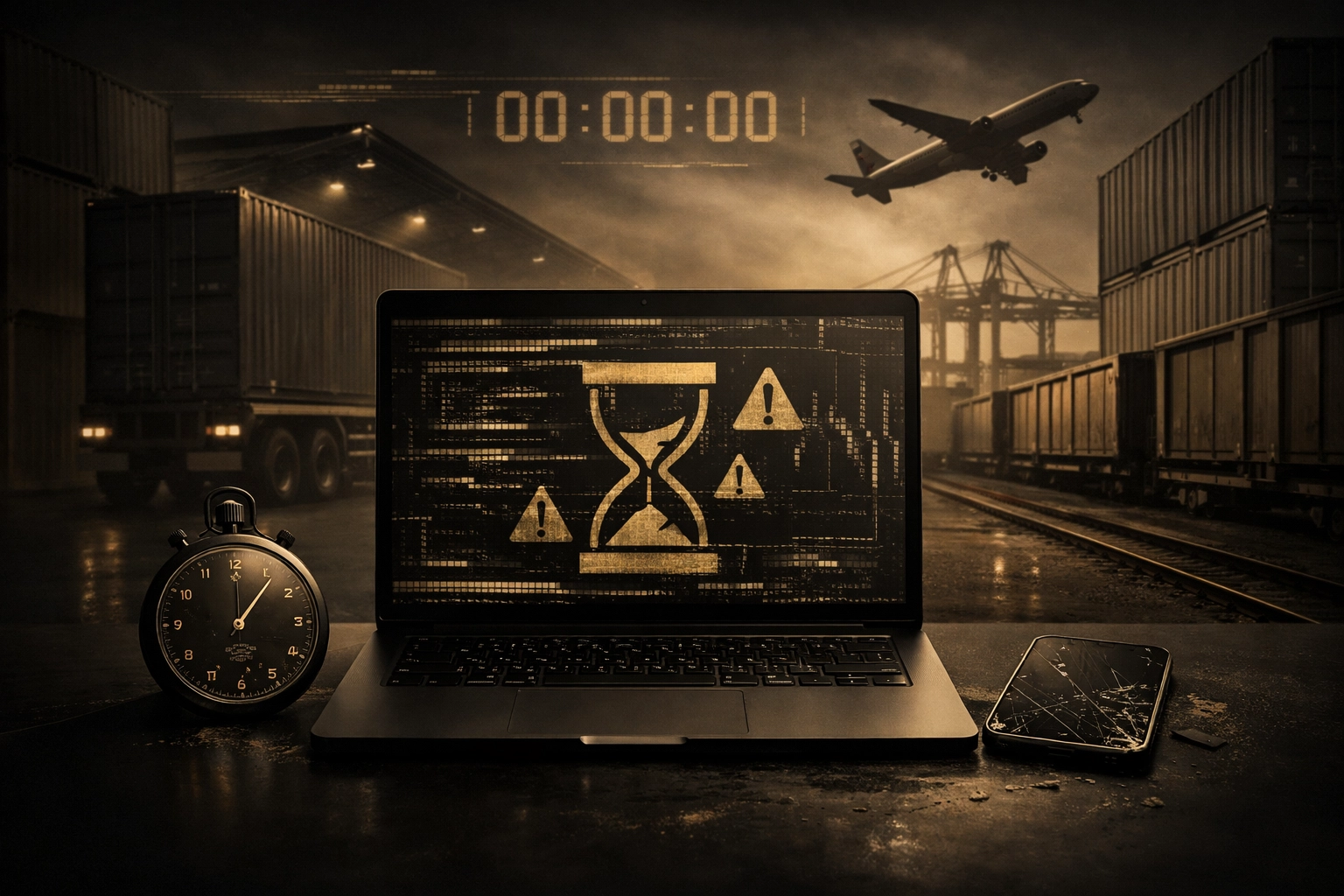
It is Sunday, the 1st of March 2026, and the UK freight and logistics landscape has never been more digitally dependent: or more vulnerable. As we step further into a year defined by hyper-automation and real-time supply chain visibility, the margin for error has effectively vanished.
At Evestaff IT Support and Consultancy, we’ve watched the industry shift from "IT as a support function" to "IT as the heartbeat of operations." If your heartbeat stops, everything else does too. For a UK-based logistics firm, a server crash or a ransomware lock-out isn't just an inconvenience; it’s a financial catastrophe that begins the moment the screen goes dark.
The Razor-Thin Edge of 2026 Logistics
In 2026, the "just-in-time" delivery model has evolved into "micro-moment" logistics. Every pallet is tracked by IoT sensors, every route is optimized by AI in real-time, and every customs declaration is handled by automated gateways. When these systems fail, the physical world grinds to a halt. Trucks sit idle at the Port of Dover, warehouse robots freeze in their tracks, and the contractual penalties begin to mount.
The logistics sector operates under a brutal reality often referred to as the "48-hour rule." Industry data suggests that if a logistics firm’s systems remain inaccessible for just two days, the result is total operational paralysis. By the 49th hour, the accrual of contractual penalties and the cost of repositioning stranded assets can become so enormous that recovery is no longer financially viable.

Visual: A high-tech logistics hub rendered in matte black and liquid gold, showing interconnected data streams pulsing through a warehouse.
The Financial Reality: Millions Lost per Hour
While many business owners look at IT costs as a line item on a budget, few accurately calculate the cost of not having functional IT. To understand the scale of the risk in 2026, we only need to look at the surrounding sectors.
In the UK manufacturing sector: which shares the same high-stakes operational complexity as logistics: unplanned downtime now costs an average of £1.36 million per hour. Some high-velocity incidents have seen losses climb as high as £49 million for a single event.
For a freight forwarder or a third-party logistics (3PL) provider, the costs are compounded by:
- SLA Penalties: Modern contracts include "failure to deliver" clauses that trigger automatically.
- Repositioning Costs: If a fleet is grounded or diverted due to a system failure, the fuel and labor costs to get back on schedule are astronomical.
- Port Demurrage: Every hour a container sits at a terminal because of a paperwork glitch is an hour you are billed for.
- Reputational Hemorrhage: In a world of instant feedback, one missed day of deliveries can lead to the loss of long-term contracts worth millions.
The Ghost of KNP Logistics: A Cautionary Tale
We don't have to look far back to see how IT failure leads to corporate extinction. The collapse of KNP Logistics remains the industry's most sobering example. A major British player, KNP was brought to its knees not by a lack of demand or rising fuel prices, but by a ransomware attack.
The cause? Relatively simple security oversights: weak passwords and a lack of two-factor authentication. The result? Bankruptcy within three months and the loss of 700 jobs.
In 2026, the threat hasn't diminished; it has matured. Ransomware is now cited by industry leaders as a greater business threat than traditional operational risks like fuel price volatility. Hackers know that the logistics sector is the "soft underbelly" of the UK economy. If they can stop a fleet, they can extort a massive payday: or simply watch the business collapse under the weight of its own stalled momentum.
Why 2026 is Different: The Complexity Trap
You might ask why downtime is so much more expensive today than it was five years ago. The answer lies in the "Complexity Trap."
In the past, if the computer went down, you could: in a pinch: revert to paper manifests and phone calls. In 2026, that is impossible. Our systems are now so integrated with Smart Motorways, automated port authorities, and customer API feeds that there is no "manual" backup.
Furthermore, 85% of logistics organizations have now implemented formal cybersecurity procedures: the highest rate of any industrial sector. While this is good news, it also means the "entry stakes" for staying in business have risen. If you aren't investing in high-tier IT resilience, you aren't just behind the curve; you are uninsurable and uncompetitive.

Visual: A sleek, liquid gold digital shield protecting a matte black freight ship, symbolizing cybersecurity as the primary defense in modern logistics.
Beyond Cyber: The Silent Killers of Productivity
It isn't always a malicious hacker that brings a company down. Often, it’s the "silent killers": legacy hardware, unpatched software, or poor integration between warehouse management systems (WMS) and transport management systems (TMS).
The UK alone loses an average of 49 hours of productivity per company every year due to these avoidable IT glitches. For a small logistics firm, that might be manageable. For a regional freight hub, 49 hours of "glitches" is the difference between a profitable year and a loss-making one.
At Evestaff IT Support and Consultancy, we focus on preventing these micro-failures before they cascade into macro-disasters. Our approach isn't just about fixing things when they break; it's about building an infrastructure that is "resilient by design."
Protecting Every Asset
When we talk about logistics, we aren't just talking about trucks and ships; we’re talking about the physical infrastructure that houses them. Managing a logistics empire in 2026 requires a 360-degree view of your assets.
Interestingly, we often see a crossover between digital security and physical asset management. For our clients who manage extensive warehouse portfolios or commercial properties, ensuring the physical state of the property is as well-documented as their digital servers is crucial. For specialized property inspections and detailed inventory management of your physical hubs, we often recommend the expertise found at propertyinventoryclerks.co.uk. Just as you wouldn't leave your server room unlocked, you shouldn't leave your physical property assets undocumented.
The Evestaff Approach: Resilience as a Service
As David Evestaff often says to our clients, "You don't buy IT support to fix computers; you buy it to protect your revenue."
In the current climate, your IT strategy should be built on three pillars:
- Redundancy: Ensuring that if one system fails, another takes over instantly.
- Vigilance: 24/7 monitoring that identifies a potential ransomware "footprint" before the encryption begins.
- Recovery: Having a "Gold Standard" backup plan that can restore operations within hours, not days, keeping you safely on the right side of that 48-hour rule.

Visual: A close-up of a liquid gold circuit board on a matte black background, representing the intricate "heartbeat" of Evestaff's IT consulting.
Final Thoughts: Can You Afford a Second?
The true cost of IT downtime in 2026 is the cost of the business itself. The UK freight and logistics sector is the backbone of our economy, but that backbone is now made of data and fiber-optic cables.
If you haven't audited your IT resilience in the last six months, you are operating on borrowed time. The complexity of 2026 doesn't forgive "adequate" IT; it only rewards the robust.
Is your infrastructure ready for the remainder of 2026?
Don't wait for the screens to go black to find out where your vulnerabilities lie. Let's ensure your fleet keeps moving and your data stays secure.
Book a Discovery Call with Evestaff IT Support and Consultancy Today
We’ll take a deep dive into your current setup, identify the bottlenecks, and build a matte-black-solid defense for your operations. In this industry, you can't afford a single second of downtime. We make sure you don't have to.

Visual: A stylized clock face where the numbers are turning from matte black into liquid gold, representing the value of time in the logistics industry.
Join The Discussion