
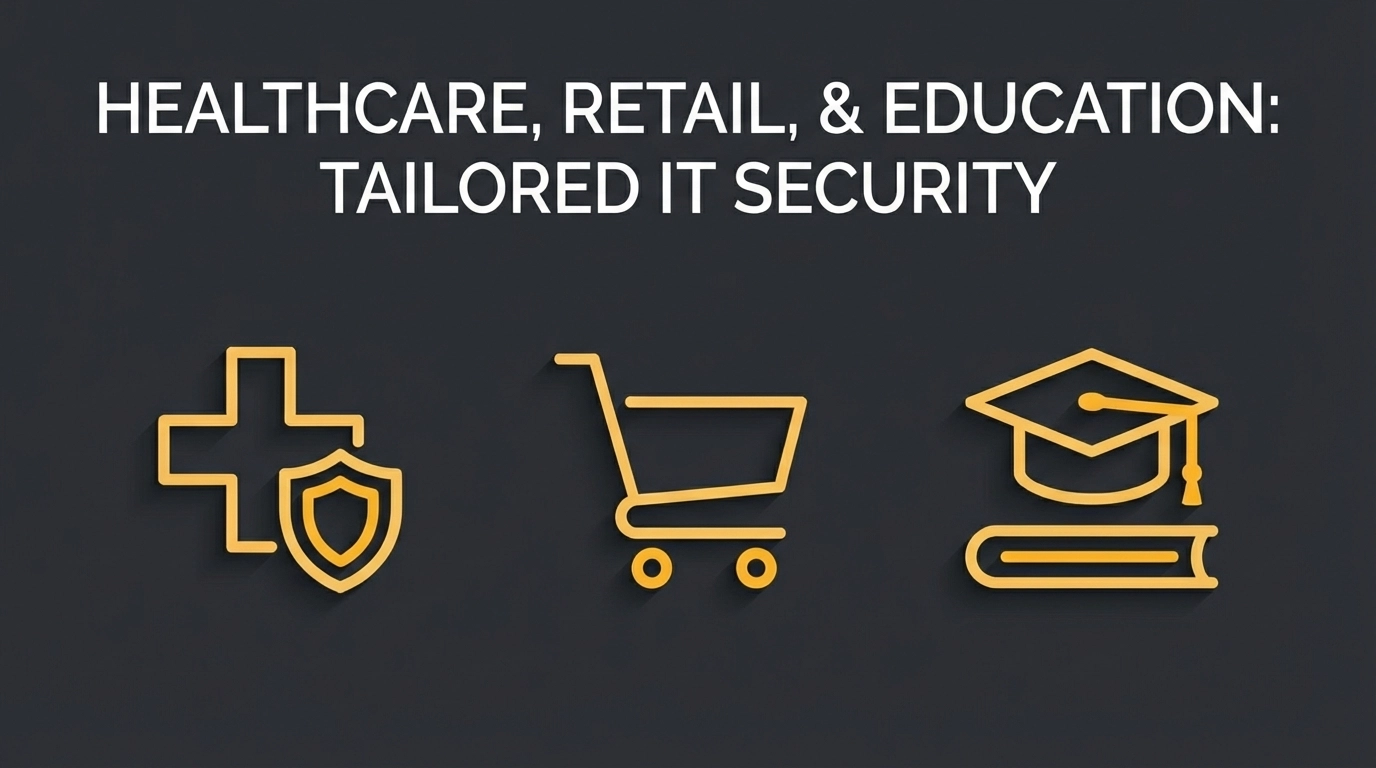
When it comes to managed IT support and security, there’s no universal fix. What keeps a GP surgery running smoothly can tie a department store in knots, and the checkout fortress that protects a retailer might leave a university’s research wide open.
Still, many organisations reach for a one-size-fits-all playbook—convenient, familiar, and a poor fit for their specific operations, regulations, and threat landscape. The right approach is tailored: designed around how you work, what you must protect, and who needs access—then managed day to day so it stays effective.
Below, we explore why healthcare, retail, and education each need tailored, managed security approaches—and how getting it wrong can cost your organisation dearly.
Healthcare: Where Lives Depend on Managed Security
Healthcare organisations face perhaps the most complex managed security challenges of any industry. They're not just protecting data; they're safeguarding patient lives, medical research, and some of the most sensitive personal information imaginable.

The Unique Data Landscape
Healthcare providers handle an extraordinary variety of sensitive data: patient medical records, prescription information, insurance details, research data, and increasingly, real-time data from connected medical devices. This information is governed by strict regulations like HIPAA (Health Insurance Portability and Accountability Act) and the GDPR, with penalties that can reach millions of pounds.
But it's not just about compliance. A ransomware attack that locks healthcare workers out of electronic health records can literally be life-threatening. In 2017, the WannaCry attack forced the NHS to cancel over 19,000 medical appointments and caused chaos across 80 NHS trusts.
Critical Infrastructure Requirements
Healthcare IT systems often include life-critical equipment: ventilators, heart monitors, MRI machines, and surgical robots. These devices frequently run on legacy operating systems that can't be easily updated, creating persistent security vulnerabilities. Yet taking them offline for security patches simply isn't an option when patients' lives are at stake.
This creates a unique security challenge: how do you protect systems that must remain operational 24/7, can't be regularly updated, and are literally keeping people alive?
The Human Factor
Healthcare workers are focused on patient care, not cybersecurity protocols. They need systems that are secure by design but don't impede their ability to access critical information quickly. A security system that requires multiple authentication steps might work fine in a corporate environment, but it becomes dangerous when it prevents a doctor from accessing a patient's allergy information during an emergency.
Retail: Where Managed Security Meets Speed
The retail sector operates in a completely different security landscape, driven by high-volume transactions, seasonal fluctuations, and ever-changing consumer expectations. It demands a tailored, managed approach that scales without slowing sales.

Payment Card Industry Compliance
Retail organisations must comply with PCI DSS (Payment Card Industry Data Security Standard), which sets strict requirements for handling, processing, and storing payment card information. Unlike healthcare's focus on protecting individual privacy, retail security centres on transaction integrity and preventing financial fraud.
A data breach in retail doesn't just affect customer trust: it can result in massive financial penalties from payment card companies, potential lawsuits, and the complete inability to process card payments. When Target suffered a breach affecting 40 million payment cards in 2013, the incident cost the company over $200 million in settlements and security improvements.
High-Volume, High-Speed Operations
Retail systems must handle enormous transaction volumes, particularly during peak periods like Black Friday or Christmas shopping. Security measures must be robust enough to prevent breaches but efficient enough to avoid slowing down checkout processes: because every second of delay during peak periods represents lost revenue.
This creates a delicate balance: how do you implement comprehensive security without affecting the customer experience or system performance during critical sales periods?
The Omnichannel Challenge
Modern retailers operate across multiple channels: physical stores, e-commerce websites, mobile apps, and increasingly, social media platforms. Each channel has different security requirements and vulnerabilities, but customer data must flow seamlessly between them.
A customer might browse products on their phone, add items to their basket on their laptop, and complete the purchase in-store. This omnichannel experience requires sophisticated security measures that protect data across all touchpoints without creating friction in the customer journey.
Education: Where Open Access Needs Tailored Protection
Educational institutions face unique security challenges that combine elements from both public and private sectors, often with limited budgets and diverse user bases—making a tailored, managed approach essential.

FERPA and Student Privacy
Educational institutions must comply with FERPA (Family Educational Rights and Privacy Act), which governs the privacy of student education records. Unlike healthcare's HIPAA or retail's PCI DSS, FERPA deals with a unique type of sensitive information: academic records, disciplinary actions, and personal development data that could affect students' futures.
Educational data breaches can have long-lasting impacts on students' lives, from identity theft to academic fraud. When a university's systems are compromised, it's not just current students at risk: alumni records spanning decades may also be exposed.
The Mixed User Environment
Educational institutions serve an incredibly diverse user base: students, faculty, administrative staff, researchers, and often external collaborators. Each group has different access needs, technical competency levels, and security awareness.
Students might need access to research databases and learning management systems but shouldn't be able to view other students' grades. Faculty members require access to academic records and research data but must be prevented from accessing financial systems. Administrative staff need broad access to operational systems but shouldn't access research data.
Research and Intellectual Property
Universities and research institutions often house valuable intellectual property: groundbreaking research, proprietary methodologies, and commercially valuable discoveries. This makes them attractive targets for industrial espionage and nation-state attacks.
The challenge lies in balancing academic openness: the free exchange of ideas that drives innovation: with the need to protect valuable research from theft or unauthorised access.
Budget Constraints and Legacy Systems
Educational institutions often operate with limited budgets and aging IT infrastructure. They may still be running critical systems on hardware and software that's years or even decades old, creating security vulnerabilities that can't be easily addressed.
Unlike private sector organisations that can budget for regular technology refreshes, educational institutions must often make do with what they have, requiring creative security solutions that work with legacy systems.
Why One-Size-Fits-All Security Fails
These three sectors illustrate why generic security approaches simply don't work. Each industry has:
Different risk tolerances: Healthcare can't afford any system downtime; retail must balance security with transaction speed; education must accommodate diverse user needs with limited resources.
Unique compliance requirements: HIPAA for healthcare, PCI DSS for retail, FERPA for education: each with different penalties, audit requirements, and technical specifications.
Distinct operational constraints: Life-critical systems in healthcare, peak-season volume in retail, academic calendars and research cycles in education.
Varied threat landscapes: Healthcare faces ransomware and medical device attacks; retail deals with payment fraud and e-commerce threats; education confronts research theft and credential attacks.

The Tailored, Managed Approach: Industry-Specific Security Strategies
Effective IT security requires understanding not just what needs to be protected, but how that protection must be implemented and managed within each industry's unique operational framework.
For healthcare, this means implementing security measures that never impede patient care, using device-specific protections for medical equipment, and ensuring compliance with multiple healthcare regulations simultaneously—all within a managed framework.
For retail, it means creating security architectures that scale with seasonal demand, protect payment processing without slowing transactions, and secure omnichannel customer journeys—all delivered via a managed service.
For education, it means developing flexible access controls that accommodate diverse user groups, protecting valuable research while maintaining academic openness, and maximising security within budget constraints—all orchestrated through a tailored, managed model.
How Evestaff Delivers Tailored, Managed Security Solutions
At Evestaff IT Support and Consultancy, we don't believe in one-size-fits-all security. We deliver tailored, managed solutions because a GP surgery's security needs are fundamentally different from a fashion retailer's, which are different again from a secondary school's.
We begin every engagement with a comprehensive assessment of your industry-specific requirements: regulatory compliance obligations, operational constraints, risk tolerance levels, and existing infrastructure. From there, we design tailored, managed security architectures that protect what matters most to your organisation while supporting, not hindering, your core operations.
Our approach extends beyond traditional IT security. Just as tailored, managed IT solutions are essential across all sectors: including real estate and property inventory services, like those found at propertyinventoryclerks.co.uk: we understand that effective cybersecurity must be customised to each industry's unique challenges and requirements.

Whether you’re protecting patient data in healthcare, securing payment transactions in retail, or safeguarding student records in education, your security approach should be tailored and managed—just like your organisation. Generic solutions breed generic vulnerabilities—and in today’s threat landscape, that’s a luxury no organisation can afford.
Don't let a one-size-fits-all approach leave your organisation vulnerable. Book a free discovery call, let's Talk – https://itandconsultancy.co.uk/lets-talk/
Join The Discussion