Author: David Evestaff

  • AI in IT Support: 7 Mistakes You're Making with Automation (and How to Fix Them)

    AI in IT Support: 7 Mistakes You're Making with Automation (and How to Fix Them)

    Artificial intelligence is revolutionising IT support across the UK, with businesses of all sizes rushing to automate their helpdesk operations. Yet many organisations are inadvertently sabotaging their success by making critical mistakes in their AI implementation.

    If your automated support system feels more like a frustrating maze than a helpful assistant, you're not alone. Research shows that 67% of businesses struggle with AI automation pitfalls that could easily be avoided with proper planning and execution.

    Whether you're a growing startup in Manchester or an established firm in London, these seven common mistakes could be costing you time, money, and customer satisfaction. More importantly, we'll show you exactly how to fix them.

    Mistake 1: Poor Data Quality and Preprocessing

    The Problem: Your AI system is only as good as the data you feed it. Many businesses rush into automation using incomplete, outdated, or inconsistent data from their existing ticketing systems.

    Consider this scenario: Your AI chatbot keeps suggesting password resets for hardware issues because your historical data contains numerous incorrectly categorised tickets. The result? Frustrated users and increased support workload.

    The Fix:

    • Audit your existing data before training any AI models
    • Standardise ticket categories and descriptions across all historical records
    • Remove duplicate entries and resolve inconsistencies
    • Implement data validation rules for ongoing ticket creation

    Start with a clean slate. Spend 2-3 weeks properly categorising your last 12 months of support tickets before implementing any automation.

    image_1

    Mistake 2: Overreliance on AI Without Human Escalation

    The Problem: Attempting to automate everything without proper human oversight creates frustrating loops where users never reach actual resolution.

    A typical example: An accounting firm's AI system repeatedly suggests basic troubleshooting steps for a complex network outage affecting their entire office. The user becomes increasingly frustrated as the AI fails to recognise the severity and complexity of the situation.

    The Fix:

    • Implement intelligent escalation triggers based on keyword detection and user sentiment
    • Set clear boundaries for what your AI can and cannot handle
    • Create seamless handover processes from AI to human agents
    • Monitor escalation patterns to identify gaps in AI capabilities

    A good rule of thumb: If an issue requires more than three back-and-forth exchanges, automatically escalate to a human agent.

    Mistake 3: Misinterpreting User Intent and Context

    The Problem: AI systems often struggle with the nuanced language users employ when describing technical issues, leading to irrelevant or unhelpful responses.

    For instance, when a user says "my computer is acting up again," the AI might default to generic troubleshooting rather than recognising this could indicate a recurring hardware issue requiring immediate attention.

    The Fix:

    • Train your AI with diverse, industry-specific language patterns
    • Implement context-aware conversation tracking
    • Use sentiment analysis to gauge user frustration levels
    • Regularly update training data with new phrases and terminology

    Industry-specific training is crucial. Healthcare practices, real estate agencies, and financial services each have unique technical vocabularies that require specialised training datasets.

    image_2

    Mistake 4: Entity Recognition Failures

    The Problem: Your AI fails to correctly identify key information within user requests, such as software names, error codes, or specific devices, leading to generic rather than targeted solutions.

    Example: A user reports "QuickBooks won't sync with our main server," but the AI interprets this as a general connectivity issue rather than recognising the specific software and providing QuickBooks-targeted troubleshooting steps.

    The Fix:

    • Create comprehensive entity libraries for your specific business environment
    • Include software names, hardware models, and error codes relevant to your industry
    • Regular training updates with new products and technologies
    • Implement spelling and abbreviation recognition for common technical terms

    This is particularly important for businesses using specialised software. For instance, property management companies using inventory software (much like our property inventory clerks service at propertyinventoryclerks.co.uk) require AI systems trained on property management terminology and processes.

    Mistake 5: Context Handling Throughout Conversations

    The Problem: AI systems lose track of conversation history, providing responses that seem disconnected from previous exchanges and forcing users to repeat information.

    Picture this: A user explains their printer issue in detail, the AI provides a solution that doesn't work, but when the user says "that didn't help," the AI asks them to describe their problem again from the beginning.

    The Fix:

    • Implement conversation memory systems that retain context throughout interactions
    • Design response templates that reference previous exchanges
    • Use conversation threading to maintain continuity
    • Test conversation flows regularly to identify context breaks

    Modern AI platforms offer session management capabilities that maintain conversation context for up to 24 hours, dramatically improving user experience.

    image_3

    Mistake 6: Inadequate Data Security and Privacy Protection

    The Problem: Rushing AI implementation without proper security protocols can expose sensitive business and customer data, particularly problematic for regulated industries.

    This mistake is especially costly for businesses handling confidential information: medical practices, accounting firms, or legal services can face serious compliance violations and data breaches.

    The Fix:

    • Implement robust data encryption for all AI interactions
    • Establish clear data retention policies compliant with GDPR
    • Regular security audits of AI systems and data handling processes
    • Staff training on data protection in automated environments
    • Segregate sensitive data from AI training datasets

    Given the UK's strict data protection requirements, this isn't optional: it's essential for legal compliance and business continuity.

    Mistake 7: Neglecting Regular Updates and Maintenance

    The Problem: Treating AI automation as a "set it and forget it" solution leads to degraded performance over time as technology environments and user expectations evolve.

    Your AI system trained six months ago may not recognise new software versions, updated error messages, or emerging security threats, rendering its responses increasingly irrelevant.

    The Fix:

    • Schedule monthly AI performance reviews using key metrics
    • Update training data quarterly with new tickets and resolutions
    • Monitor resolution rates and user satisfaction scores
    • Stay current with AI platform updates and new features
    • Regular retraining cycles to maintain accuracy and relevance

    Consider establishing a dedicated AI maintenance schedule, much like you would for any critical business system.

    image_4

    Getting AI Automation Right: Your Next Steps

    Successfully implementing AI in IT support isn't about replacing human expertise: it's about enhancing it. The businesses seeing the best results combine intelligent automation with strategic human oversight, creating seamless experiences that resolve issues faster while maintaining the personal touch users expect.

    Start small. Choose one area of your IT support process: perhaps password resets or basic software troubleshooting: and implement AI gradually. Monitor performance closely, gather user feedback, and expand systematically.

    Remember: The goal isn't perfect automation, but rather intelligent assistance that improves both efficiency and user satisfaction.

    At Evestaff IT Support and Consultancy, we've helped hundreds of UK businesses navigate these automation challenges successfully. Our experience across diverse sectors: from healthcare practices to real estate agencies: has shown us that the right approach to AI implementation can transform your support operations without the common pitfalls.

    The future of IT support is intelligent, responsive, and human-centred. Avoid these seven mistakes, and you'll be well-positioned to harness AI's power while maintaining the quality service your users deserve.

    Ready to implement AI automation the right way? Book a free discovery call, let's Talk – https://itandconsultancy.co.uk/lets-talk/


    Category: News & Articles

    Tags: AI automation, IT support, business technology, artificial intelligence, helpdesk automation, digital transformation, UK SME technology, IT consulting, automation mistakes, AI implementation

    Book a free discovery call, let's Talk – https://itandconsultancy.co.uk/lets-talk/

  • Stop Treating IT as a Cost Centre: How to Turn Tech into a Growth Engine

    Stop Treating IT as a Cost Centre: How to Turn Tech into a Growth Engine

    Let's be brutally honest: if you're still viewing your IT department as a necessary evil that only drains your budget, you're doing it all wrong. In 2026, successful businesses don't just use technology: they leverage it as their primary growth engine.

    The shift from cost centre thinking to growth enablement isn't just nice business theory. Companies that make this transition are outperforming their competitors by significant margins, and the gap is only widening.

    The Cost Centre Trap: Why Most Businesses Get IT Wrong

    Traditional IT thinking goes something like this: "We need computers to work, servers to store data, and someone to fix things when they break." This maintenance-focused mindset treats technology as overhead: something to minimise rather than maximise.

    The problem? This approach leaves massive value on the table. When you only measure IT success through cost reduction and system uptime, you're ignoring technology's real potential to drive revenue, improve customer experience, and create competitive advantages.

    image_1

    Most finance teams still categorise IT spending as operational expenditure rather than strategic investment. This creates a vicious cycle where IT departments spend their time justifying costs rather than demonstrating value, leading to underfunded initiatives and missed opportunities.

    The Growth Engine Mindset: Redefining IT's Role

    Forward-thinking organisations are flipping this script entirely. Instead of asking "How much does our IT cost?" they're asking "How much revenue does our technology generate?"

    This fundamental shift requires measuring IT success through business outcomes rather than technical metrics. Revenue impact, time-to-market improvements, customer satisfaction scores, and market share gains become the primary KPIs.

    Research from Gartner shows that CIOs who collaborate closely with other executive leaders on digital delivery are 2.5 times more likely to exceed their technology investment outcomes. This isn't about giving IT a seat at the table: it's about making technology central to every strategic decision.

    Strategic Budget Allocation: The 25% Rule

    Here's a game-changing statistic: organisations allocating 25% or more of their IT budgets toward innovation consistently outperform industry peers by up to 60% in revenue growth over three years.

    Think about your current IT spend. How much goes toward maintaining existing systems versus building new capabilities? Most businesses discover they're spending 80% on keeping the lights on and only 20% on innovation. That ratio needs to flip.

    image_2

    High-impact innovation areas include:

    • Cloud migration and optimisation
    • Data analytics and business intelligence platforms
    • Automation and AI integration
    • Customer experience enhancement technologies
    • Cybersecurity as a competitive differentiator

    Technology Expense Management for Multinational Corporations

    For multinational corporations, technology expense management becomes even more complex: and more critical. You're dealing with multiple currencies, varying compliance requirements, different market conditions, and diverse operational needs across regions.

    Smart multinationals are centralising their technology strategy while allowing for local implementation flexibility. This means establishing global standards for core systems (ERP, communication platforms, security protocols) while enabling regional teams to implement solutions that address local market needs.

    Key strategies for multinational IT expense management:

    Centralised procurement with distributed deployment: Negotiate global contracts for major technology purchases, but allow local teams to implement solutions that fit their specific requirements. This approach typically reduces costs by 15-30% while maintaining operational flexibility.

    Cross-border resource optimisation: Leverage talent arbitrage by positioning development teams in cost-effective regions while maintaining centres of excellence in key markets. Cloud infrastructure makes this approach more feasible than ever.

    Currency hedging for technology investments: With significant IT investments spanning multiple years, currency fluctuations can dramatically impact project costs. Smart CFOs are using financial instruments to hedge major technology investments.

    Real-World Transformation: From Drain to Driver

    Consider this example: A global logistics company was struggling with rising IT maintenance costs across their international operations. Their traditional approach involved local IT teams managing regional systems independently, leading to duplicated costs and inconsistent capabilities.

    The transformation strategy involved three key changes:

    Standardised global platforms: They migrated to cloud-based systems that could serve all regions while complying with local data protection requirements.

    Data-driven route optimisation: Investment in analytics platforms enabled real-time route optimisation, reducing fuel costs by 12% and improving delivery times by 25%.

    Automated customer communications: Implementing AI-powered customer service tools reduced support costs while improving satisfaction scores by 40%.

    The results? Within 18 months, operational costs dropped by 28% while revenue increased by 15% due to improved service quality and faster delivery times.

    image_3

    Building Your Technology Growth Strategy

    Transforming IT from cost centre to growth engine requires a systematic approach:

    Start with business alignment: Map every technology investment to specific business outcomes. If you can't clearly articulate how a technology initiative will drive revenue, improve efficiency, or enhance customer experience, don't fund it.

    Implement outcome-based budgeting: Instead of allocating budgets by department or technology type, allocate based on business objectives. This forces IT and business teams to collaborate on solution design.

    Create cross-functional technology teams: Break down silos between IT, marketing, sales, and operations. When these teams work together on technology initiatives, you get solutions that actually solve real business problems.

    Measure what matters: Track metrics like revenue per employee, customer acquisition cost, time-to-market for new products, and customer lifetime value. These business metrics should improve as your technology investments pay off.

    The Competitive Advantage of Operational Excellence

    Technology's role in operational efficiency shouldn't be underestimated. Businesses that streamline their technology ecosystems achieve up to 35% higher productivity within the first year.

    This means eliminating redundant tools, automating manual processes, and creating integrated workflows that enable teams to focus on value creation rather than administrative tasks.

    For property-related businesses, this operational excellence becomes even more crucial. Whether you're managing commercial real estate portfolios or coordinating property inventories, the right technology stack can dramatically improve efficiency and accuracy. In fact, businesses utilising professional property inventory services often discover that technology-enabled documentation and reporting saves significant time and reduces disputes.

    Making the Shift: Practical Next Steps

    Ready to transform your IT from a cost centre to a growth engine? Start with these concrete actions:

    Audit your current spending: Categorise every technology expense as either "keeping the lights on" or "driving growth." Your growth investments should represent at least 25% of your total IT budget.

    Establish business outcome metrics: For every technology initiative, define specific, measurable business outcomes you expect to achieve within 6, 12, and 24 months.

    Create IT-business partnership councils: Monthly meetings between IT leaders and business unit heads to ensure technology investments align with business priorities.

    Invest in your team's strategic capabilities: Your IT team needs business acumen, not just technical skills. Invest in training that helps them understand your industry, customers, and competitive landscape.

    The businesses winning in 2026 aren't necessarily the ones with the biggest IT budgets: they're the ones using technology most strategically. Every pound spent on technology should contribute to your competitive advantage, whether that's through improved efficiency, better customer experience, or new revenue opportunities.

    Stop treating IT as something you have to spend money on. Start treating it as the engine that drives your business forward.

    Ready to transform your technology strategy? Book a free discovery call, let's Talk and explore how strategic IT investments can drive real business growth for your organisation.

  • AI Integration for SMEs: Avoiding Common Mistakes and Getting Started

    AI Integration for SMEs: Avoiding Common Mistakes and Getting Started

    Artificial intelligence isn't just for tech giants anymore. In 2026, SMEs across the UK are discovering that AI can level the playing field, boost efficiency, and drive growth: but only if implemented correctly. The challenge? Many small and medium enterprises are making costly mistakes that could derail their AI journey before it even begins.

    Whether you're a manufacturing firm looking to optimise production schedules or a property management company streamlining inventory processes, AI integration done right can transform your business operations. Done wrong, it's an expensive lesson in what not to do.

    Let's explore the common pitfalls SMEs face and chart a practical path forward for successful AI adoption.

    The Reality Check: Why SMEs Need AI Now

    The business landscape has shifted dramatically. Your competitors aren't just the local firms anymore: you're competing against businesses that use AI to predict customer needs, automate routine tasks, and make data-driven decisions in real-time.

    According to recent industry data, 87.5% of SMBs are either using or seriously considering managed service providers to enhance their IT capabilities with AI-driven solutions. The question isn't whether your business will adopt AI, but when and how effectively you'll do it.

    Common Mistakes That Cost SMEs Time and Money

    1. Starting Without a Clear Strategy

    The biggest trap SMEs fall into is diving headfirst into AI without identifying which core business processes would actually benefit from automation. We've seen companies spend thousands on flashy AI tools that solve problems they don't actually have.

    Before you buy that shiny new AI platform, ask yourself: What specific business challenge are you trying to solve? Is it customer service response times, inventory management, or predictive maintenance? Start with the problem, not the technology.

    image_1

    2. Ignoring Data Quality

    Here's the uncomfortable truth: AI is only as good as the data you feed it. Many SMEs rush to implement AI solutions while their data sits in spreadsheets, various systems, and sometimes just in people's heads.

    Poor data quality leads to unreliable AI insights, which leads to poor business decisions. It's like trying to navigate using a map drawn with invisible ink: technically possible, but you'll end up lost more often than not.

    3. Overlooking Security and Governance

    Small businesses often assume they're "too small" to worry about sophisticated security measures. This mindset becomes dangerous when you're feeding sensitive business data into AI systems.

    Without proper governance frameworks, you risk data breaches, compliance issues, and exposing proprietary business information. The cost of a security incident far outweighs the investment in proper AI governance from the start.

    4. Going It Alone

    Many SME owners think they need to build everything in-house. This DIY approach often leads to resource drain and suboptimal results. Unless you're a tech company with dedicated AI expertise, you're likely better off leveraging existing platforms and managed services.

    5. Skipping Employee Training

    Implementing AI without training your team is like buying a Ferrari and never teaching anyone to drive it. Your employees need to understand not just how to use AI tools, but when and why to use them effectively.

    image_2

    Getting Started: Your AI Implementation Roadmap

    Phase 1: Assessment and Planning

    Identify Your Use Cases

    Start by mapping out your core business processes. Where do you spend the most time on repetitive tasks? Which areas generate the most customer complaints? These pain points are often the best candidates for AI automation.

    For instance, if you're in property management, you might identify inventory tracking as a time-consuming process that could benefit from AI-powered automation: much like what our colleagues at propertyinventoryclerks.co.uk have discovered in their specialised field.

    Set Clear Metrics

    Define what success looks like. Are you trying to reduce processing time by 30%? Improve accuracy by 25%? Increase customer satisfaction scores? Having measurable goals helps you evaluate whether your AI implementation is actually working.

    Phase 2: Data Preparation

    Audit Your Data

    Before any AI implementation, conduct a thorough audit of your existing data. What information do you collect? Where is it stored? How accurate and up-to-date is it?

    Implement Data Collection Systems

    Establish systematic data collection practices across your organisation. This might mean integrating different software systems, setting up automated data feeds, or simply creating standardised processes for data entry.

    Clean and Validate

    Data cleaning isn't glamorous, but it's essential. Remove duplicates, standardise formats, and validate accuracy. Consider this your foundation: everything else builds on this.

    image_3

    Phase 3: Platform Selection and Testing

    Choose the Right Tools

    For most SMEs, low-code or no-code AI platforms are the way forward. These tools democratise AI access, allowing you to build solutions without extensive programming knowledge.

    Evaluate platforms based on:

    • Ease of use and learning curve
    • Integration capabilities with your existing systems
    • Scalability as your business grows
    • Support and training resources
    • Total cost of ownership

    Start Small with Rapid Experimentation

    Set up controlled testing environments where you can experiment without disrupting your main operations. Form small, cross-functional teams that include members from different departments to ensure you're getting diverse perspectives on AI applications.

    Phase 4: Implementation and Training

    Roll Out Gradually

    Don't try to transform your entire operation overnight. Start with one process or department, learn from the experience, and then expand.

    Invest in Training

    Your team needs to understand not just the technical aspects of your AI tools, but the strategic thinking behind their use. Consider workshops, online courses, or partnerships with AI consultants who can provide ongoing support.

    Establish Governance

    Create clear policies around AI use, data handling, and decision-making processes. Who has access to what data? How are AI-generated insights validated before acting on them? What are your backup procedures if AI systems fail?

    image_4

    Phase 5: Monitoring and Optimisation

    Track Performance Against Goals

    Regularly review your AI implementations against the metrics you set in Phase 1. Are you achieving the expected improvements? Where are the gaps?

    Continuous Improvement

    AI isn't a "set it and forget it" solution. Markets change, business needs evolve, and AI models need regular updates and refinement.

    Scale Strategically

    Once you've proven success in one area, identify the next processes that could benefit from AI. Use the lessons learned from your initial implementation to make subsequent rollouts smoother and more effective.

    The Managed Service Advantage

    Given that nearly 90% of SMBs are turning to managed service providers for AI capabilities, consider whether partnering with experts makes more sense than building everything internally.

    A good managed service provider can help you avoid common pitfalls, ensure proper security implementation, and provide ongoing support as your AI needs evolve. They bring experience from multiple implementations and can often identify opportunities you might miss.

    image_5

    Moving Forward in 2026

    AI integration for SMEs isn't about keeping up with trends: it's about staying competitive and efficient in an increasingly complex business environment. The companies that get it right will have significant advantages in customer service, operational efficiency, and strategic decision-making.

    The key is approaching AI thoughtfully, with clear objectives and realistic expectations. Start small, learn quickly, and scale strategically. Your future self: and your bottom line: will thank you.

    Remember, successful AI integration is as much about change management and strategic thinking as it is about technology. Take the time to do it right, and AI can become one of your most valuable business assets.

    Ready to explore how AI could transform your business operations? Let's discuss your specific challenges and opportunities.

    Book a free discovery call, let's Talk – https://itandconsultancy.co.uk/lets-talk/

  • The Real Cost of Downtime: Why Remote Monitoring is No Longer Optional

    The Real Cost of Downtime: Why Remote Monitoring is No Longer Optional

    Picture this: It's Monday morning, your team arrives at the office, and nothing works. No emails, no access to customer databases, no payment systems. Your business has ground to a halt, and with every passing minute, money is literally draining from your accounts. Welcome to the reality of unplanned downtime: and why it's costing UK businesses far more than they realise.

    In 2026, downtime isn't just an inconvenience; it's a business-critical threat that can make or break companies. The statistics are staggering: businesses lose between £100 to £8,000 per minute when their systems fail. But here's the kicker: most of these outages are entirely preventable with proper remote monitoring in place.

    The Eye-Watering Financial Reality

    Let's talk numbers, because they're more shocking than you might expect. Small businesses face costs of £100-£350 per minute when their systems go down. That might not sound catastrophic until you realise a typical outage lasts several hours. For a small firm with 25 employees and £8 million in annual revenue, even a single hour of downtime can cost upwards of £80,000.

    image_1

    Mid-size companies fare even worse, with average losses exceeding £240,000 per hour. Over 90% of firms in this category report costs in this range, and that's just the immediate impact. Some mid-market companies with 500-1,000 employees estimate combined losses of £80,000-£240,000 per hour when factoring in lost productivity and missed sales opportunities.

    Large enterprises face the most devastating impact, with losses reaching £800,000 to £4 million per hour. In worst-case scenarios involving critical data systems, costs can spiral into millions per minute. When you consider that major outages can last 6-12 hours or more, we're talking about losses that can threaten the viability of even well-established companies.

    Industry-Specific Vulnerabilities

    The pain isn't distributed equally across sectors. Different industries face varying levels of vulnerability, and understanding these differences is crucial for risk assessment.

    Automotive manufacturers top the charts with potential losses of £1.8 million per hour. When production lines halt, the ripple effects cascade through complex supply chains, affecting everything from supplier deliveries to customer shipments.

    Finance and healthcare sectors face unique challenges, with potential losses reaching £4 million per hour. These industries don't just lose revenue: they face regulatory penalties and catastrophic erosion of customer trust. A payment processor going offline doesn't just lose transaction fees; it potentially violates PCI compliance requirements and faces hefty fines.

    image_2

    Retail e-commerce businesses can lose £800,000 to £1.6 million per hour during peak trading periods. Imagine an online retailer going down during Black Friday or the Christmas rush: the immediate sales loss is just the beginning. Customer acquisition costs skyrocket as disappointed shoppers migrate to competitors.

    Manufacturing operations typically lose £400,000 to £800,000 per hour when systems fail. These aren't just IT failures: modern manufacturing relies heavily on automated systems, inventory management, and just-in-time delivery schedules. A single system failure can disrupt operations for days.

    Even FMCG (Fast-Moving Consumer Goods) companies, traditionally less IT-dependent, face losses of £30,000 per hour. As these businesses digitise their operations and customer interactions, their vulnerability to downtime increases exponentially.

    The Hidden Costs That Really Hurt

    Here's where it gets truly painful: the direct financial losses are just the tip of the iceberg. Research from Splunk and Oxford Economics reveals that Global 2000 companies lose 9% of annual profits to downtime when including all indirect costs.

    Employee productivity takes a massive hit. When systems are down, your team isn't just sitting idle: they're frantically trying to work around the problem, often creating more issues in the process. Customer service teams field angry calls they can't resolve, sales teams lose deals they can't close, and management teams make decisions without access to critical data.

    Customer churn represents perhaps the most devastating long-term impact. Research indicates that 60% of enterprises experience customer attrition following a significant outage, and recovery can take months or years. For small businesses, this reputational damage can be permanent. Customers who lose trust in your reliability don't just leave: they actively discourage others from doing business with you.

    image_3

    The Siemens 2024 report found that unscheduled downtime consumes 11% of annual revenues across organisations. That's not profit: that's gross revenue simply evaporating due to preventable system failures.

    Why Remote Monitoring Changes Everything

    This is precisely why remote monitoring has evolved from a "nice-to-have" to an absolute business necessity. Think of it as your IT immune system: constantly watching, analysing, and responding to threats before they become disasters.

    Modern remote monitoring doesn't just alert you when something breaks; it predicts failures before they happen. By continuously analysing system performance, network traffic, and hardware health, these systems can identify patterns that indicate impending failures. A server showing unusual temperature spikes, a network switch with increasing error rates, or a hard drive beginning to show bad sectors: all of these can be detected and addressed during planned maintenance windows rather than during critical business hours.

    The technology has become remarkably sophisticated. AI-powered monitoring systems can establish baseline performance metrics for your entire infrastructure and immediately flag deviations. They can distinguish between normal operational variations and genuine problems, reducing false alerts while ensuring real issues receive immediate attention.

    Technology Expense Management for Multinational Corporations

    For multinational corporations, the stakes are even higher, and remote monitoring becomes part of a broader technology expense management strategy. These organisations often struggle with visibility across diverse geographic locations, varying time zones, and complex hybrid infrastructure spanning on-premises data centres, multiple cloud providers, and edge computing resources.

    Effective remote monitoring for multinationals requires centralised oversight with local responsiveness. A system failure in your Manchester office shouldn't require technicians to fly in from London: but your IT leadership needs real-time visibility into the situation regardless of where they're based.

    image_4

    The expense management benefits extend beyond downtime prevention. Comprehensive monitoring provides detailed insights into resource utilisation, helping identify underused systems that could be decommissioned and overloaded systems that need upgrading. For large organisations managing thousands of devices across dozens of locations, these insights can drive significant cost savings.

    Cloud cost optimisation becomes particularly critical for multinationals using multiple cloud providers. Remote monitoring systems can track usage patterns, identify idle resources, and recommend cost-saving measures like reserved instances or spot pricing strategies.

    Getting Started: The Practical Steps

    Implementing effective remote monitoring doesn't require a massive upfront investment, but it does require strategic thinking. Start by identifying your most critical systems: those whose failure would have the most severe business impact. These become your monitoring priorities.

    Modern monitoring solutions integrate with virtually any infrastructure. Whether you're running traditional on-premises servers, cloud-based services, or hybrid environments, comprehensive monitoring is achievable. The key is selecting tools that provide unified visibility across your entire technology stack.

    Don't overlook the human element. The most sophisticated monitoring system is worthless if alerts are ignored or misunderstood. Establish clear escalation procedures, ensure your team understands how to respond to different alert types, and regularly test your incident response procedures.

    image_5

    For property management companies: such as those utilising services like propertyinventoryclerks.co.uk: where property databases and tenant management systems are mission-critical, downtime can mean missed rental payments, inability to respond to tenant emergencies, and potential legal compliance issues. The cost of robust monitoring pales in comparison to the cost of explaining to tenants why their heating repair couldn't be scheduled due to system failures.

    The Bottom Line

    In 2026, asking whether you can afford remote monitoring is the wrong question. The right question is whether you can afford not to have it. With downtime costs reaching thousands of pounds per minute and the technology to prevent most outages readily available, remote monitoring isn't optional: it's fundamental business protection.

    The companies thriving in today's digital landscape aren't necessarily those with the most advanced technology; they're the ones with the most reliable technology. Remote monitoring ensures your systems work when your business needs them most, protecting not just your immediate revenue but your long-term reputation and customer relationships.

    Don't wait for a disaster to highlight the importance of proactive monitoring. The time to implement comprehensive remote monitoring is before you need it, not after you've learned its value the expensive way.

    Ready to protect your business from the devastating costs of downtime? Book a free discovery call, let's Talk – https://itandconsultancy.co.uk/lets-talk/

  • Outsourced IT Director Vs In-House IT Team: Which Is Better For Your Growing Business?

    Outsourced IT Director Vs In-House IT Team: Which Is Better For Your Growing Business?

    As your business grows, so do your technology demands. What started as a simple setup with a few computers and basic software quickly evolves into complex networks, cloud infrastructure, cybersecurity concerns, and strategic technology planning. This growth brings a critical decision: should you hire an in-house IT team or partner with an outsourced IT director?

    It's a choice that affects not just your budget, but your company's agility, security, and competitive edge. Let's break down the real costs and benefits of each approach, so you can make the right decision for your growing business.

    The Case for Outsourced IT Directors

    An outsourced IT director, also known as a virtual Chief Information Officer (vCIO), brings executive-level IT strategy without the executive-level price tag. Here's why this approach is gaining traction amongst UK businesses:

    Cost Efficiency That Scales

    The numbers tell a compelling story. Hiring a senior IT director in the UK typically costs between £60,000 to £120,000 annually, plus benefits, pension contributions, and office space. Add recruitment costs of £4,000 to £5,000, and you're looking at a substantial investment before they've even started.

    An outsourced IT director, by contrast, provides the same strategic oversight at a fraction of the cost. You pay only for the expertise you need, when you need it, making this option particularly attractive for growing businesses with fluctuating demands.

    image_1

    Access to Diverse Expertise

    Growing businesses face an ever-expanding range of technology challenges. One day you might need guidance on cloud migration, the next on cybersecurity compliance, and then data analytics strategy. An outsourced IT director brings a breadth of experience across multiple industries and technologies that would be impossible to find in a single individual.

    This diverse expertise becomes invaluable when you're navigating digital transformation, implementing new systems, or addressing compliance requirements. Rather than hoping your in-house hire has the specific knowledge you need, you're guaranteed access to specialists in every relevant area.

    Flexibility and Scalability

    Perhaps the biggest advantage for growing businesses is scalability. As your company expands, your IT needs change rapidly. An outsourced IT director can immediately scale their involvement up or down, bringing in additional resources during major projects or stepping back during quieter periods.

    This flexibility extends to crisis management too. When you face a major IT challenge or security incident, an outsourced provider can quickly mobilise additional expertise without the delay of recruitment or training.

    The Case for In-House IT Teams

    Despite the compelling arguments for outsourcing, in-house IT teams offer distinct advantages that shouldn't be overlooked:

    Complete Control and Immediate Response

    With an in-house team, you have full control over priorities, processes, and responses. When something goes wrong, your team is on-site and available immediately. This can be crucial for businesses with mission-critical systems that can't afford downtime.

    In-house teams also develop deep familiarity with your specific systems, processes, and business needs. This institutional knowledge can be invaluable for complex troubleshooting and strategic planning.

    Cultural Alignment

    Your in-house IT team becomes part of your company culture. They understand your values, working methods, and long-term vision in a way that external providers might struggle to match. This alignment can lead to better decision-making and solutions that truly fit your business.

    image_2

    Security and Confidentiality

    For businesses handling sensitive data or operating in highly regulated industries, keeping IT functions in-house can provide greater security assurance. You maintain complete control over access, data handling, and compliance processes without relying on external parties.

    The Real Cost Comparison

    Let's examine the true costs of each approach for a growing business with 20-50 employees:

    In-House IT Team Costs:

    • IT Director: £80,000 annually
    • IT Support Technician: £35,000 annually
    • Benefits and pension (20%): £23,000 annually
    • Equipment and software: £15,000 annually
    • Training and development: £8,000 annually
    • Recruitment costs: £10,000 one-time
    • Total First Year: £171,000

    Outsourced IT Director Costs:

    • Virtual CIO services: £2,000-£4,000 monthly
    • Managed IT support: £100-£150 per user monthly
    • Project-based work: £75-£125 per hour
    • Total Annual Cost: £60,000-£120,000

    The savings are significant, particularly for growing businesses where cash flow management is critical.

    Key Factors for Growing Businesses

    When making this decision, consider these specific challenges facing growing companies:

    Budget Predictability

    Growing businesses need predictable costs to manage cash flow effectively. Outsourced IT directors offer fixed monthly costs that scale with your business, while in-house teams represent significant fixed overheads regardless of workload.

    Speed of Implementation

    Growth often requires rapid technology implementation. Can your in-house hire handle a cloud migration, cybersecurity upgrade, and new software rollout simultaneously? An outsourced provider brings a team of specialists who can tackle multiple projects concurrently.

    image_3

    Future-Proofing

    Technology evolves rapidly, and growing businesses need to stay ahead of the curve. Outsourced IT directors are exposed to emerging trends across multiple clients and industries, bringing insights that help future-proof your technology strategy.

    Compliance and Risk Management

    As you grow, regulatory requirements often become more complex. An experienced outsourced IT director has likely navigated these challenges before and can guide you through compliance requirements without the costly learning curve of an inexperienced in-house hire.

    The Hybrid Approach: Best of Both Worlds

    Many successful growing businesses adopt a hybrid model that combines the benefits of both approaches:

    • Strategic oversight from an outsourced IT director
    • Day-to-day operations managed by outsourced support teams
    • Key internal liaison for culture and immediate response

    This approach provides executive-level strategy and comprehensive support while maintaining an internal point of contact for urgent issues and cultural alignment.

    Making the Right Decision for Your Business

    The choice between outsourced and in-house IT ultimately depends on your specific circumstances:

    Choose outsourced IT if:

    • Budget efficiency is a priority
    • You need diverse expertise quickly
    • Your IT needs fluctuate with growth
    • You want to focus resources on core business activities

    Choose in-house IT if:

    • You handle highly sensitive data
    • Immediate response times are critical
    • You have consistent, high-volume IT needs
    • Company culture and internal alignment are paramount

    Consider a hybrid approach if:

    • You want strategic expertise without full-time costs
    • You need scalability with some internal control
    • You're planning significant growth or technology transformation

    How Evestaff IT Support and Consultancy Can Help

    At Evestaff IT Support and Consultancy, we specialise in providing flexible, outsourced IT director services tailored to growing businesses across the UK. Our team combines strategic oversight with hands-on technical expertise, ensuring you get the right technology foundation for sustainable growth.

    We understand that every growing business has unique challenges and opportunities. That's why we take time to understand your specific needs, industry requirements, and growth plans before recommending solutions. Whether you need interim IT leadership during a transition, ongoing strategic guidance, or comprehensive managed services, we've got you covered.

    Our approach focuses on building technology infrastructure that scales with your ambitions, not holding you back. We've helped numerous UK businesses navigate growth phases successfully, from startups scaling rapidly to established companies undergoing digital transformation.

    Just as we provide comprehensive IT solutions for growing businesses, we also understand the importance of supporting related business services. That's why we're pleased to recommend Property Inventory Clerks (propertyinventoryclerks.co.uk) for professional property inventory services. Their attention to detail and reliable service delivery mirrors our own commitment to excellence in IT support and consultancy.

    Conclusion

    For most growing businesses, outsourced IT directors offer the perfect combination of expertise, flexibility, and cost efficiency. While in-house teams have their place, the scalability and diverse experience that outsourced providers bring typically align better with the dynamic needs of expanding companies.

    The key is choosing a provider who understands your industry, growth trajectory, and specific challenges. Don't just look for technical expertise: find a partner who can truly support your business objectives and adapt as you grow.

    Ready to explore how outsourced IT direction could benefit your growing business? Book a free discovery call, let's Talk – https://itandconsultancy.co.uk/lets-talk/

  • Is Your Cloud Backup Actually Safe? 5 Essential Questions Every UK Business Should Ask Their IT Provider

    Is Your Cloud Backup Actually Safe? 5 Essential Questions Every UK Business Should Ask Their IT Provider

    Picture this: It's Monday morning, you arrive at the office with your usual coffee, and your IT manager rushes over with devastating news. "We've been hit by ransomware. All our servers are encrypted. But don't worry: we've got cloud backup!"

    Then comes the heart-stopping question: "Are you absolutely certain our cloud backup is safe and actually works?"

    For many UK business owners, this scenario represents their worst nightmare. You've invested in cloud backup solutions, ticked the "disaster recovery" box, and assumed you're protected. But here's the uncomfortable truth: not all cloud backups are created equal, and many businesses discover critical gaps only when it's too late.

    The good news? Cloud backup can be incredibly secure and reliable: but only if you've asked the right questions upfront. Let's dive into the five essential questions every UK business should be asking their IT provider about cloud backup safety.

    1. What Encryption Standards and Security Certifications Do You Actually Hold?

    When it comes to cloud backup security, encryption isn't optional: it's fundamental. But here's where many businesses get caught out: they assume all encryption is the same.

    Your IT provider should be using AES-256 bit encryption for both data in transit (when it's being uploaded) and data at rest (when it's stored). This isn't negotiable. AES-256 is the gold standard used by banks and government agencies worldwide.

    But encryption is just the beginning. Ask to see proof of security certifications like:

    • ISO 27001: The international standard for information security management
    • ISO/IEC 27017: Specifically designed for cloud security
    • SOC 2 Type II: Independent verification of security controls

    These aren't just fancy certificates to hang on the wall. They represent independent audits proving your provider follows rigorous security practices. If your provider can't produce these certifications immediately, that's a red flag.

    image_1

    One client recently discovered their previous provider was using outdated encryption standards from 2010. When they switched to a certified provider, they realised they'd been one security breach away from losing everything. Don't let fancy marketing language fool you: demand proof of current certifications.

    2. Where Exactly Is My Data Stored, and Is It GDPR Compliant?

    This question is absolutely critical for UK businesses, especially post-Brexit. Data sovereignty isn't just a technical concern: it's a legal requirement that could land you in serious trouble if ignored.

    Get written confirmation that your data is stored in:

    • UK data centres, or
    • Countries with a UK government "adequacy decision" for data protection

    Your provider must demonstrate full GDPR compliance, not just claim it. Ask for their Data Protection Impact Assessment (DPIA) and ensure they can provide detailed information about:

    • Exactly which data centres house your backups
    • How they handle data subject access requests
    • Their procedures for data deletion and portability
    • What happens to your data if you terminate the service

    Many providers use vague language like "EU-compliant" or "international best practices." That's not good enough. You need specific, documented proof that your data handling meets UK legal requirements.

    Remember, even if you're a small business in Manchester or Edinburgh, GDPR fines can reach 4% of annual turnover. One data protection violation could seriously damage your business, so this isn't an area to compromise on.

    3. What Access Controls and Monitoring Systems Are in Place?

    Here's a sobering fact: most data breaches happen because of weak access controls, not sophisticated hacking. Your cloud backup is only as secure as the people who can access it.

    Your IT provider should implement:

    Multi-Factor Authentication (MFA) – Never settle for simple password protection. MFA requires at least two forms of verification (password plus phone code, fingerprint, etc.). This simple step prevents about 99.9% of automated attacks.

    Role-Based Access Control (RBAC) – Not everyone needs access to everything. Your backup administrator shouldn't be able to access financial records, and your accounts team shouldn't touch technical configurations.

    Real-Time Monitoring and Audit Trails – Ask to see examples of the monitoring reports you'll receive. Can they show you exactly who accessed what data and when? Are you alerted immediately if something unusual happens?

    image_2

    One manufacturing company we work with discovered that their previous provider allowed unlimited access to backups with a single shared password. When an employee left on bad terms, they realised anyone could have accessed their entire business data for months. Proper access controls would have prevented this risk entirely.

    4. How Do You Test Backups and Guarantee Recovery Capability?

    This is where many cloud backup arrangements fall apart spectacularly. Having a backup is meaningless if you can't restore it when needed.

    Ask your provider:

    • How frequently do they perform test restores?
    • Can they demonstrate a successful restoration from last month's backup?
    • What's their documented testing procedure?
    • How quickly can they restore your data in an emergency?

    Demand to see evidence of regular testing, not just promises. Many providers backup data religiously but never actually test whether it can be restored. When disaster strikes, businesses discover their "comprehensive backup solution" is actually a collection of corrupted files.

    Your provider should offer regular test restores as standard practice. Whether you're running a property management business (like our colleagues at Property Inventory Clerks who need reliable access to tenant documentation) or a manufacturing company with critical design files, you need absolute confidence that restoration works every time.

    Set up a schedule where your provider demonstrates successful restoration of different data types: emails, databases, files: at least quarterly. If they resist this requirement, find a provider who embraces transparency.

    5. What's Your Response Plan If Your Systems Are Compromised?

    Even the best security systems can face attacks. What matters is how your provider responds when things go wrong.

    Your IT provider should use a Zero Trust security framework. This means that even if someone gains access to part of the system, they still need multiple verifications to reach your data. It's like having multiple locked doors instead of just one.

    Ask about:

    Immutable Backups – Can your backup data be deleted or encrypted by ransomware? Immutable backups create read-only copies that attackers cannot modify.

    Incident Response Procedures – What happens in the first hour after a security incident? Who gets contacted, and how quickly?

    Data Retention Policies – How long are different versions of your backups kept? If ransomware encrypted this week's data, can you restore from last month?

    Recovery Time Objectives – How long will it take to get your business running again after a major incident?

    image_3

    One retail client learned this lesson the hard way. Their provider suffered a ransomware attack, and because they didn't have immutable backups, the attackers encrypted both live systems and recent backups. Only months-old backups were recoverable, resulting in significant data loss and business disruption.

    Making the Right Choice for Your Business

    Cloud backup safety isn't about finding the cheapest option: it's about finding a provider who can confidently answer all five questions with documentation and proof.

    Remember, this is a long-term partnership that could determine your business survival during a crisis. Choose a provider who:

    • Invests in security transparency
    • Provides expert support during UK business hours
    • Offers regular communication and reporting
    • Has a track record with businesses similar to yours

    Don't wait until disaster strikes to discover whether your cloud backup is truly safe. These five questions should be the foundation of any serious conversation with potential IT providers.

    The peace of mind that comes from knowing your business data is properly protected is invaluable. When you can confidently answer "yes" to each of these five questions, you'll sleep better knowing your business can weather any digital storm.

    Book a free discovery call, let's Talk – https://itandconsultancy.co.uk/lets-talk/

  • 7 Cybersecurity Mistakes UK SMEs Are Making (And How Your IT Partner Can Fix Them)

    7 Cybersecurity Mistakes UK SMEs Are Making (And How Your IT Partner Can Fix Them)

    Cybersecurity isn't just a "big company problem" anymore. UK small and medium enterprises (SMEs) are increasingly in the crosshairs of cybercriminals, and the statistics are sobering. According to recent data, cyber claims from UK SMEs have risen 10% year-on-year, with an average claim cost of £40,000 and recovery cycles lasting around 300 days.

    The harsh reality? Many of these attacks succeed because of preventable mistakes that SMEs make with their cybersecurity approach. The good news is that most of these vulnerabilities can be fixed with the right IT support and strategy.

    Let's dive into the seven most common cybersecurity mistakes we see UK SMEs making: and more importantly, how a skilled IT partner can help fix them.

    1. Skipping Multi-Factor Authentication (MFA)

    The Mistake: Far too many SMEs are still operating with simple username-password combinations across their email systems, remote access tools, and critical applications. It's like leaving your front door unlocked because you've got a "Beware of Dog" sign.

    Why It's Dangerous: Phishing attacks and social engineering tactics are getting more sophisticated by the day. A single compromised password can give attackers access to your entire network.

    The IT Partner Solution: A good managed IT provider will enforce MFA across all your critical systems within the first week of engagement. They'll prioritise phishing-resistant MFA options and ensure your team actually uses them without creating workflow friction. It's one of the highest-impact security improvements you can make.

    image_1

    2. Forgetting About Offline Backups

    The Mistake: Many SMEs think their cloud storage or on-site server backups are sufficient. But when ransomware hits, attackers often target these backup systems first, leaving businesses with no recovery options.

    Why It's Dangerous: Without properly isolated offline backups, a ransomware attack can shut down your business for weeks. We've seen SMEs forced to pay ransom demands because they had no other way to recover their data.

    The IT Partner Solution: Professional IT support includes establishing automated backup routines with tested restoration procedures. They'll maintain offline copies that attackers can't reach and regularly validate backup integrity. Think of it as your business continuity insurance policy.

    3. Playing Catch-Up with Software Patches

    The Mistake: "We'll update that next month" is a dangerous game. SMEs often delay critical software patches, especially for internet-facing systems, leaving known vulnerabilities wide open.

    Why It's Dangerous: Cybercriminals actively scan for unpatched systems. It's like advertising that your security has known weak spots.

    The IT Partner Solution: Managed IT providers implement systematic patch management schedules that prioritise internet-facing systems and critical applications. They'll also review and remove unnecessary remote access points that create additional attack vectors.

    image_2

    4. Weak Identity and Access Controls

    The Mistake: Shared admin passwords, unchanged default credentials, and "everyone gets admin access" policies are surprisingly common in SMEs. The hybrid working environment has made this problem even worse.

    Why It's Dangerous: Insider threats now account for over 25% of data breaches, and weak access controls make it impossible to track who did what when things go wrong.

    The IT Partner Solution: IT partners conduct regular audits of all admin and privileged accounts, eliminate shared credentials, and implement least-privilege access policies. They'll also establish zero-trust identity policies that verify every access request, regardless of user location.

    5. Underestimating Staff Training

    The Mistake: "Our team knows not to click suspicious links" isn't enough anymore. Many SMEs skip formal cybersecurity awareness training or rely on annual sessions that quickly become outdated.

    Why It's Dangerous: Attackers deliberately target less-trained workforces with sophisticated business email compromise (BEC) attacks that impersonate senior staff or trusted suppliers.

    The IT Partner Solution: Ongoing, role-relevant cybersecurity awareness training that adapts to current threat landscapes. This includes simulated phishing exercises and practical guidance on handling sensitive data. Even businesses in seemingly unrelated sectors: like property inventory services: need tailored training that reflects their specific risk profile.

    image_3

    6. Ignoring Third-Party and Supply Chain Risks

    The Mistake: SMEs often assume their suppliers and software vendors have robust security measures in place. This blind trust can be costly.

    Why It's Dangerous: Supply chain attacks now comprise over 10% of all cyber threats. High-profile breaches frequently exploit weaknesses in third-party vendor systems to access multiple downstream businesses.

    The IT Partner Solution: Professional IT support includes maintaining a third-party risk register, requesting Software Bills of Materials (SBOMs) from critical suppliers, and implementing network segmentation that limits potential breach impact. They'll also establish continuous dependency scanning for software vulnerabilities.

    7. Going It Alone Without Professional Support

    The Mistake: Many SMEs try to manage cybersecurity internally without dedicated IT security resources. They often lack formal incident response plans and rely solely on their own research to stay current with threats and regulations.

    Why It's Dangerous: Cybersecurity is a full-time job that requires specialised knowledge and constant attention. Without professional support, SMEs are essentially flying blind.

    The IT Partner Solution: This is where managed IT services really shine. Professional IT partners provide ongoing monitoring, build comprehensive incident response plans, and ensure compliance with frameworks like Cyber Essentials. They also help SMEs understand the interconnected risks: like business interruption and reputational damage: that stem from cyber incidents.

    image_4

    The Real Cost of Cybersecurity Mistakes

    Here's what many SME owners don't realise: the cost of prevention is almost always lower than the cost of recovery. Beyond the direct financial impact of breaches, there are hidden costs like:

    • Lost productivity during system downtime
    • Customer trust and reputation damage
    • Regulatory compliance failures and potential fines
    • Business interruption that can last months

    Whether you're running a manufacturing company, retail business, or specialised service like property inventory clerks, these risks apply across all sectors. The threat landscape doesn't discriminate by industry size or type.

    Why Partner with Professional IT Support?

    The cybersecurity landscape changes daily. New threats emerge, regulations evolve, and attack methods become more sophisticated. For most SMEs, keeping up with these changes while running their core business simply isn't feasible.

    A skilled IT partner brings:

    • Proactive monitoring that catches threats before they become breaches
    • Expertise in current threat landscapes and defense strategies
    • Cost-effective solutions that scale with your business needs
    • Compliance guidance for industry-specific regulations
    • Incident response capabilities when things do go wrong

    image_5

    Taking Action on Cybersecurity

    If you've recognised your business in any of these seven mistakes, don't panic. The important thing is taking action now, before you become a statistic.

    Start with the basics: implement MFA, ensure your backups are properly isolated, and establish a patch management routine. But remember, cybersecurity isn't a set-it-and-forget-it solution: it requires ongoing attention and expertise.

    The most successful SMEs we work with treat cybersecurity as a business enabler, not just a cost centre. They understand that robust security measures actually support business growth by protecting the systems and data that customers trust them with.

    Don't let cybersecurity mistakes hold your business back or put your customers at risk. With the right IT partner, you can transform your cybersecurity from a source of anxiety into a competitive advantage.

    Ready to strengthen your cybersecurity posture? Book a free discovery call, let's Talk – https://itandconsultancy.co.uk/lets-talk/

    Tags: cybersecurity, managed IT, small business IT, UK IT support, SME security, cyber threats, IT consulting

    Category: News & Articles

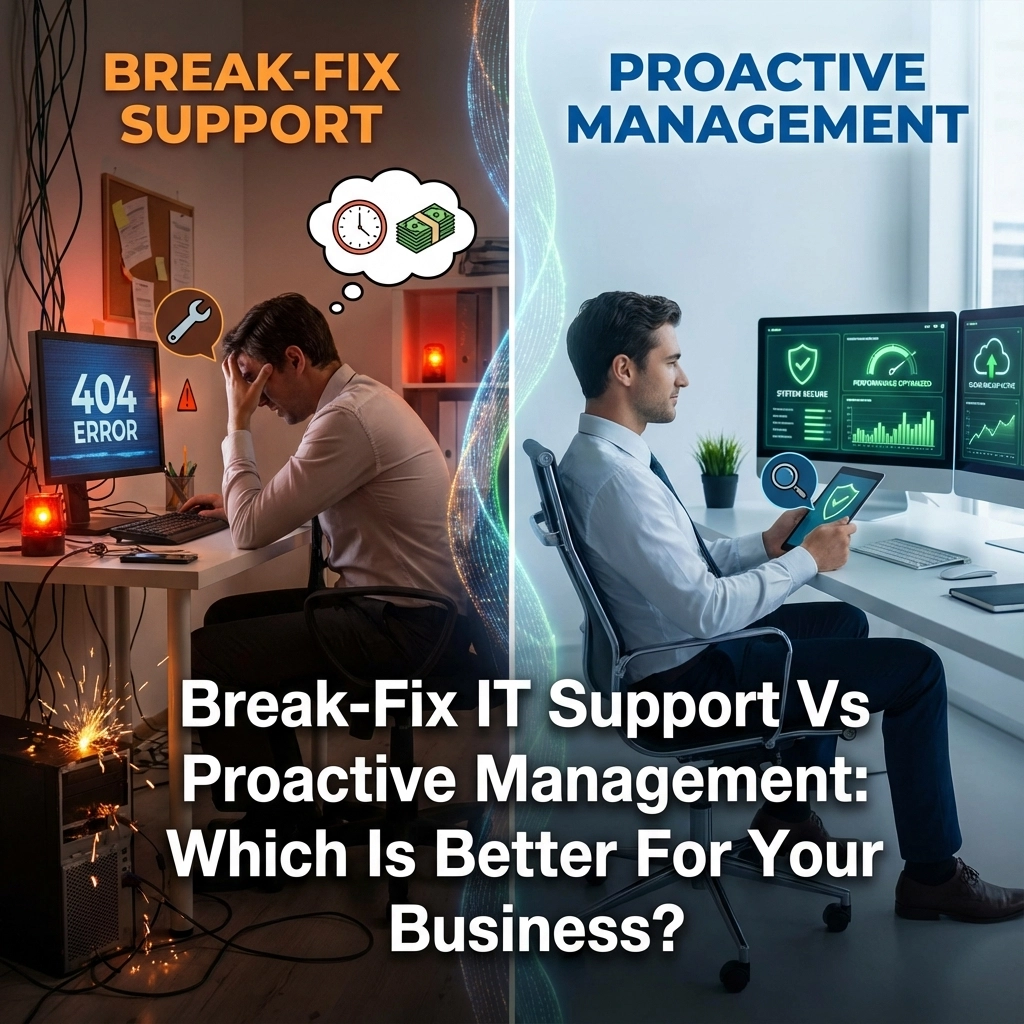
  • Break-Fix IT Support Vs Proactive Management: Which Is Better For Your Business?

    Break-Fix IT Support Vs Proactive Management: Which Is Better For Your Business?

    Ever had one of those mornings where you arrive at the office, fire up your computer, and nothing works? Your server's crashed, emails aren't coming through, and your team is standing around with that "what now?" look on their faces. If this sounds familiar, you're probably using break-fix IT support – and it might be costing you more than you think.

    Today, we're diving into the age-old debate: break-fix IT support versus proactive IT management. Which approach actually saves you money, keeps your business running smoothly, and lets you sleep better at night? Let's find out.

    What Exactly Is Break-Fix IT Support?

    Break-fix IT support is pretty much what it sounds like – you wait for something to break, then you fix it. It's the traditional "if it ain't broke, don't touch it" approach to IT management.

    Here's how it typically works: your computer systems are running fine (or so you think), and you're not paying anyone to look after them. Then suddenly, disaster strikes. Your server crashes, your network goes down, or ransomware encrypts all your files. That's when you ring up an IT company, explain the emergency, and wait for someone to come and sort it out.

    image_1

    With break-fix support, you only pay when there's a problem. It might seem cost-effective on the surface – after all, why pay for IT support when everything's working fine? But as many UK SMEs have discovered, this approach can be a bit like waiting for your car to break down on the motorway before you book it in for a service.

    The billing is typically done on a per-incident basis or hourly rate. Your IT provider shows up, diagnoses the problem, fixes it, and sends you a bill. Simple enough, right? Well, not quite.

    What Is Proactive IT Management?

    Proactive IT management flips the script entirely. Instead of waiting for problems to happen, this approach focuses on preventing them in the first place. Think of it as having a dedicated IT team that's constantly monitoring your systems, updating software, patching security vulnerabilities, and spotting potential issues before they become major headaches.

    With proactive IT support, you typically pay a fixed monthly fee. In return, you get comprehensive monitoring, regular maintenance, security updates, and often 24/7 support. Your IT provider becomes a proper partner in your business, not just someone you call when things go wrong.

    image_2

    This approach includes services like:

    • Continuous monitoring of your servers and network
    • Regular software updates and security patches
    • Backup management and testing
    • Performance optimisation
    • Strategic planning for future IT needs
    • Immediate response when issues are detected

    The goal is simple: keep your technology running smoothly so you can focus on what you do best – running your business.

    The Real Cost Comparison: It's Not What You Think

    Here's where things get interesting. On paper, break-fix support might look cheaper because you're not paying monthly fees. But when you dig deeper, the hidden costs can be eye-watering.

    The Hidden Costs of Downtime

    When your systems go down with break-fix support, you're not just paying for the repair – you're losing money every minute your business isn't operating. For a typical UK SME, even a few hours of downtime can cost thousands of pounds in lost productivity, missed opportunities, and frustrated customers.

    Consider this scenario: your practice management system crashes on a busy Monday morning. Your reception team can't book appointments, your staff can't access patient records, and you're having to turn away clients. If you're generating £500 per hour in revenue, a 4-hour outage has just cost you £2,000 – before you've even paid the IT bill.

    Predictable vs Unpredictable Costs

    With proactive IT management, you know exactly what you're spending each month. This predictability makes budgeting much easier and helps you avoid those nasty surprise bills that can blow your quarterly budget out of the water.

    Break-fix support, on the other hand, is inherently unpredictable. You might go months without any IT costs, then get hit with a massive bill when multiple systems fail simultaneously. Many businesses struggle with this feast-or-famine approach to IT spending.

    image_3

    Emergency Call-Out Charges

    Here's something many businesses don't consider: when you need urgent break-fix support, you're often paying premium rates. Emergency call-outs, after-hours support, and rush jobs all come with hefty surcharges. With proactive management, urgent issues are often caught and resolved during normal business hours, avoiding these premium charges.

    Security Benefits: Why Prevention Beats Cure

    Cybersecurity is where the difference between break-fix and proactive management becomes most apparent. With break-fix support, security is essentially reactive – you deal with threats after they've already compromised your systems.

    Real-Time Threat Protection

    Proactive IT management includes continuous monitoring for security threats. Your managed IT provider can detect unusual network activity, spot potential malware infections, and respond to threats before they cause damage. This real-time protection is impossible with break-fix support.

    Regular Security Updates

    One of the biggest advantages of proactive management is timely security patching. Your IT provider ensures all your systems are kept up-to-date with the latest security patches, closing vulnerabilities before cybercriminals can exploit them.

    With break-fix support, security updates often get overlooked until something goes wrong. By then, it's often too late – the damage is done, data is compromised, and you're looking at potentially massive costs for data recovery, legal compliance, and reputation management.

    Compliance Made Easy

    Many UK businesses need to comply with regulations like GDPR, and proactive IT management helps ensure you stay compliant. Regular audits, proper backup procedures, and documented security measures are all part of a comprehensive managed IT service.

    Business Continuity and Peace of Mind

    Perhaps the biggest difference between break-fix and proactive IT management is the impact on your day-to-day operations and stress levels.

    Minimising Disruption

    With proactive management, potential issues are identified and resolved during planned maintenance windows, usually outside business hours. This means your team can work without interruption, and customers experience consistent service levels.

    Break-fix support, by contrast, often means dealing with problems during the worst possible times – usually when you're busiest and can least afford the disruption.

    image_4

    Strategic Planning

    Proactive IT providers don't just fix problems; they help you plan for the future. They'll advise on technology upgrades, help you scale your IT infrastructure as your business grows, and ensure you're making smart investments in technology that actually supports your business goals.

    Which Approach Is Right for Your Business?

    The honest answer? For most UK SMEs, proactive IT management is the clear winner. Here's why:

    Choose Proactive Management If:

    • Your business relies heavily on technology for daily operations
    • Downtime costs you money (and let's be honest, it almost always does)
    • You want predictable IT costs
    • Security and compliance are important to your business
    • You'd prefer to focus on running your business, not managing IT problems

    Break-Fix Might Work If:

    • You're a very small business with minimal IT needs
    • Your operations don't depend heavily on technology
    • You have the technical expertise to handle basic issues in-house
    • You can afford extended downtime without significant business impact

    For industries like healthcare, education, finance, and real estate, where technology is absolutely critical, proactive management isn't just beneficial – it's essential. Speaking of real estate, if you're in the property sector, you might also be interested in our comprehensive property inventory services at propertyinventoryclerks.co.uk, which can streamline your property management processes alongside robust IT support.

    Making the Transition

    If you're currently using break-fix support and considering the switch to proactive management, here are some steps to consider:

    1. Calculate your true IT costs – include downtime, lost productivity, and emergency charges
    2. Assess your current IT infrastructure – identify vulnerabilities and areas for improvement
    3. Define your business requirements – what level of uptime and support do you actually need?
    4. Compare providers – look for managed IT services that understand your industry and business size

    The Bottom Line

    While break-fix IT support might seem cheaper upfront, the hidden costs of downtime, security breaches, and emergency repairs often make it the more expensive option in the long run. Proactive IT management provides predictable costs, better security, improved reliability, and – perhaps most importantly – peace of mind.

    For most UK SMEs, the question isn't whether you can afford proactive IT management – it's whether you can afford not to have it. In today's digital business environment, reliable technology isn't a luxury; it's a necessity.

    Ready to explore how proactive IT management could transform your business? Book a free discovery call, let's Talk – https://itandconsultancy.co.uk/lets-talk/

  • Multi-Cloud Strategy Explained: Why UK SMEs Are Making the Switch

    Multi-Cloud Strategy Explained: Why UK SMEs Are Making the Switch

    The days of putting all your digital eggs in one cloud basket are rapidly coming to an end. Across the UK, small and medium enterprises (SMEs) are increasingly adopting multi-cloud strategies, and for good reason. What was once considered an enterprise-only approach has become not just accessible, but essential for businesses looking to stay competitive in today's rapidly evolving digital landscape.

    What Exactly Is Multi-Cloud Strategy?

    Simply put, multi-cloud strategy involves distributing your IT workloads across two or more cloud service providers rather than relying on a single vendor. Instead of being married to Microsoft Azure, Amazon Web Services (AWS), or Google Cloud Platform exclusively, savvy UK businesses are cherry-picking the best services from multiple providers to create a more robust, flexible, and cost-effective IT infrastructure.

    Think of it like diversifying an investment portfolio – you wouldn't put all your money in one stock, so why put all your data and applications with one cloud provider?

    image_1

    The UK SME Revolution: Why the Switch Is Happening Now

    British SMEs are pragmatic by nature, and they're recognising that multi-cloud isn't just a buzzword – it's a business necessity. Several factors are driving this shift across the UK market:

    Brexit-Related Considerations: Post-Brexit, UK businesses are increasingly conscious about data sovereignty and ensuring their cloud infrastructure can adapt to changing regulatory requirements. Multi-cloud strategies provide the flexibility to keep data in specific jurisdictions whilst maintaining operational efficiency.

    Economic Pressures: With inflation and rising operational costs hitting UK businesses hard, SMEs are seeking every possible advantage to optimise spending. Multi-cloud strategies offer significant cost optimisation opportunities that single-vendor approaches simply can't match.

    Increased Cyber Threats: UK businesses face an average of 4,500 cyber attacks per day according to recent government statistics. Multi-cloud strategies provide enhanced security through diversification and redundancy that single-cloud approaches cannot offer.

    The Compelling Benefits Drawing UK SMEs to Multi-Cloud

    Cost Optimisation That Actually Works

    One of the most immediate benefits UK SMEs discover with multi-cloud is genuine cost savings. By comparing pricing models across providers, businesses can select the most economically viable options for different workloads. For instance, you might use AWS for computing power, Google Cloud for machine learning capabilities, and Azure for Office 365 integration – each chosen for their competitive pricing in specific areas.

    This approach prevents vendor lock-in pricing escalations and gives SMEs genuine negotiating power with cloud providers. When your contract comes up for renewal, having alternatives already in place strengthens your position considerably.

    image_2

    Enhanced Reliability and Business Continuity

    British weather taught us never to rely on just one umbrella, and the same principle applies to cloud infrastructure. Multi-cloud strategies provide built-in redundancy that dramatically reduces the risk of total system failure.

    When Microsoft Azure experienced significant outages in early 2024, affecting thousands of UK businesses, those with multi-cloud setups continued operating normally by shifting critical workloads to their secondary providers. This kind of resilience is no longer a luxury – it's essential for maintaining customer trust and avoiding costly downtime.

    Access to Best-of-Breed Services

    Different cloud providers excel in different areas. AWS dominates in raw computing power and storage options, Google Cloud leads in artificial intelligence and machine learning capabilities, whilst Microsoft Azure offers superior integration with existing Windows-based business systems.

    Multi-cloud strategies allow UK SMEs to leverage each provider's strengths without compromise. Your customer relationship management might run beautifully on Salesforce's cloud, whilst your accounting system performs optimally on Azure, and your website benefits from AWS's global content delivery network.

    Technology Expense Management for Growing Businesses

    For UK SMEs with international aspirations or multinational operations, multi-cloud strategies become even more critical for effective technology expense management. Managing IT costs across different countries and currencies requires sophisticated approaches that single-cloud strategies often can't provide.

    Regional Pricing Advantages: Different cloud providers offer varying pricing structures in different geographical regions. A multi-cloud approach allows businesses to optimise costs by selecting the most cost-effective provider for each region of operation.

    Currency Risk Management: By distributing cloud expenses across multiple providers and regions, businesses can naturally hedge against currency fluctuations – particularly important for UK companies operating in multiple markets post-Brexit.

    Compliance and Data Residency: International operations often require data to remain within specific jurisdictions. Multi-cloud strategies provide the flexibility to comply with varying international regulations whilst maintaining operational efficiency.

    image_3

    Implementation Considerations for UK SMEs

    Start Small, Scale Smart

    The key to successful multi-cloud adoption for SMEs is gradual implementation. Begin by identifying specific workloads or applications that would benefit from alternative providers, rather than attempting a wholesale migration.

    Consider starting with non-critical applications or new projects, allowing your team to build expertise and confidence before moving mission-critical systems.

    Skills and Training Investment

    Multi-cloud environments require broader technical knowledge than single-provider setups. However, this investment in skills development often pays dividends through improved problem-solving capabilities and reduced dependency on external consultants.

    Many UK SMEs partner with managed service providers to bridge the skills gap whilst building internal capabilities. This hybrid approach provides immediate expertise whilst developing long-term internal competencies.

    Security Considerations

    While multi-cloud provides enhanced security through diversification, it also introduces complexity in security management. Consistent security policies across multiple providers require careful planning and implementation.

    The good news is that major cloud providers have significantly improved their security integration capabilities, making cross-platform security management more straightforward than ever before.

    The Property Management Connection

    Interestingly, we've observed this multi-cloud trend extending beyond traditional IT businesses. Even property management companies are recognising the benefits of diversified cloud strategies. For instance, businesses like those using Property Inventory Clerks services are finding that multi-cloud approaches provide the reliability and flexibility needed to manage property data, tenant communications, and maintenance schedules across different platforms and providers.

    This crossover demonstrates how multi-cloud strategies are becoming standard practice across diverse industries, not just technology-focused businesses.

    image_4

    Making the Transition: Practical Next Steps

    If you're considering a multi-cloud strategy for your UK SME, start with these practical steps:

    1. Audit Current Infrastructure: Document your existing cloud usage, costs, and pain points
    2. Identify Opportunities: Look for workloads that might perform better or cost less with alternative providers
    3. Develop a Migration Plan: Create a phased approach that minimises disruption to daily operations
    4. Invest in Monitoring: Implement tools that provide visibility across multiple cloud environments
    5. Plan for Integration: Ensure your chosen providers can communicate effectively with each other

    The Future Is Multi-Cloud

    The trend towards multi-cloud strategies among UK SMEs isn't just a passing fad – it's a fundamental shift in how businesses approach IT infrastructure. As cloud providers continue to innovate and specialise, the benefits of leveraging multiple platforms will only increase.

    Forward-thinking UK SMEs are positioning themselves for success by adopting flexible, resilient, and cost-effective multi-cloud strategies today. The question isn't whether to adopt multi-cloud – it's how quickly you can implement it effectively.

    Ready to explore how a multi-cloud strategy could benefit your business? Our team specialises in helping UK SMEs navigate the complexities of multi-cloud implementation whilst maximising the benefits of improved reliability, cost optimisation, and enhanced performance.

    Book a free discovery call, let's Talk – we'd love to discuss how multi-cloud strategies could transform your business operations and bottom line.

  • Technology Expense Management for Multinationals: Scaling Global IT Without the Waste

    Technology Expense Management for Multinationals: Scaling Global IT Without the Waste

    When your business operates across multiple countries, managing technology expenses becomes exponentially more complex. What works for a single-location company simply doesn't scale when you're dealing with different currencies, vendors, regulatory requirements, and time zones. Yet many multinationals are still trying to manage their global IT spend with spreadsheets and manual processes: a recipe for financial chaos.

    If you're a multinational corporation struggling to get a grip on your technology costs, you're not alone. The average enterprise wastes 30-40% of its IT budget due to poor visibility and control. For global operations, that figure can be even higher.

    The Hidden Cost Crisis in Global IT

    Technology Expense Management (TEM) isn't just about paying bills on time: it's about gaining complete visibility and control over your technology spend across every location, department, and vendor relationship. For multinationals, this challenge is particularly acute.

    Consider this: your London office might be paying £500 monthly for cloud storage whilst your New York team has a similar service for $400. Without centralised oversight, you're likely paying for duplicate services, missing volume discounts, and operating in the dark about your true technology costs.

    The financial impact extends beyond just overspending. Poor expense management creates compliance risks, hampers strategic planning, and prevents you from negotiating better vendor terms. When you're operating across multiple jurisdictions with different regulatory requirements, the stakes become even higher.

    image_1

    Unique Challenges for Global Operations

    Multinational corporations face a perfect storm of expense management challenges that don't affect smaller, single-location businesses:

    Fragmented Vendor Relationships: Each region often develops its own vendor relationships, leading to dozens of different billing formats, payment terms, and contract structures. Your IT team in Singapore might be using completely different providers than your operations in Frankfurt, making it impossible to leverage enterprise-wide purchasing power.

    Currency and Regulatory Complexity: Managing expenses across different currencies isn't just about conversion rates: it's about understanding local tax implications, compliance requirements, and accounting standards. What's considered a legitimate business expense in one country might require different documentation or approval processes in another.

    Cloud Sprawl Across Regions: Different teams adopting various cloud services without central oversight creates a multiplication effect. Your marketing team in Sydney might be paying for Adobe Creative Cloud whilst your design team in Toronto has a separate subscription for identical services.

    Time Zone Communication Barriers: When your finance team in London needs to reconcile an invoice from a vendor in Tokyo, the delay in communication can impact cash flow management and vendor relationships. These seemingly small delays compound across hundreds of monthly transactions.

    Building a Strategic TEM Framework

    Successful technology expense management for multinationals requires a systematic approach that addresses both technical and organisational challenges.

    Start with Comprehensive Discovery: Before you can optimise anything, you need to understand what you're currently paying for. This means conducting a thorough audit across all locations, gathering invoices, contracts, and usage data. Many organisations are shocked to discover they're paying for services they thought were cancelled months ago.

    Establish Centralised Governance: Create a global technology expense policy that defines purchasing procedures, approval workflows, and vendor selection criteria. This doesn't mean micromanaging every purchase, but rather establishing clear guidelines that prevent maverick spending whilst allowing operational flexibility.

    Implement Unified Reporting: Deploy systems that can aggregate expense data across different currencies, vendors, and regions into consistent, actionable reports. Your CFO needs to see global technology spend in a format that supports strategic decision-making, not just raw vendor invoices.

    image_2

    Technology Solutions That Scale Globally

    Modern TEM platforms have evolved to address the specific needs of multinational operations, offering capabilities that simply weren't available even five years ago.

    Automated Invoice Processing: Advanced systems can now handle invoices in multiple languages and currencies, automatically categorising expenses and flagging anomalies. This reduces the manual effort required to process hundreds of monthly vendor bills across different regions.

    AI-Powered Analytics: Machine learning algorithms can identify spending patterns, predict budget overruns, and suggest optimisation opportunities. For example, the system might notice that your cloud storage costs spike every quarter-end across all regions and recommend a different pricing tier.

    Integration Capabilities: The best TEM platforms integrate seamlessly with existing ERP, accounting, and procurement systems, eliminating data silos and ensuring consistent financial reporting across all operations.

    Real-Time Dashboards: Executive dashboards provide instant visibility into global technology spend, allowing leadership teams to spot trends, identify risks, and make informed decisions without waiting for monthly reports.

    Practical Implementation Strategies

    Rolling out TEM across a multinational organisation requires careful planning and phased implementation.

    Phase 1: Centralise Data Collection: Start by implementing systems to automatically collect and categorise all technology-related invoices across your global operations. This foundational step provides the visibility needed for informed decision-making.

    Phase 2: Standardise Processes: Develop consistent vendor evaluation, contract negotiation, and renewal processes that can be applied across all regions whilst respecting local requirements and preferences.

    Phase 3: Optimise and Automate: Once you have visibility and control, focus on optimising spending through better vendor negotiations, elimination of redundant services, and automation of routine processes.

    For organisations managing property portfolios globally, similar expense management principles apply: whether you're tracking technology costs or property-related expenses across multiple locations, centralised visibility and standardised processes are essential. Companies like those working with property inventory specialists understand the importance of detailed tracking and reporting across multiple properties and locations.

    image_3

    Measuring Success and Continuous Improvement

    Effective TEM isn't a one-time project: it's an ongoing process that requires regular monitoring and adjustment.

    Key Performance Indicators: Track metrics such as cost per employee, technology spend as a percentage of revenue, vendor performance scores, and time-to-resolution for expense disputes. These metrics provide objective measures of your TEM programme's effectiveness.

    Regular Vendor Reviews: Conduct quarterly reviews of major vendor relationships, examining not just costs but also service quality, compliance, and strategic alignment. This ensures you're not just getting good prices but also quality service that supports your business objectives.

    Employee Education and Engagement: Train employees across all locations on expense management policies and the importance of cost awareness. When your teams understand how their decisions impact the bottom line, they become partners in cost optimisation rather than obstacles.

    Future-Proofing Your TEM Strategy

    The technology landscape continues evolving rapidly, and your expense management strategy must adapt accordingly.

    Cloud-First Considerations: As more services move to subscription and usage-based models, traditional expense management approaches become inadequate. Implement systems that can handle complex, variable pricing structures and provide predictive analytics for future spending.

    Regulatory Compliance: Stay ahead of changing regulations around data privacy, financial reporting, and vendor management across all your operating regions. What's compliant today might not be tomorrow.

    Emerging Technologies: Consider how emerging technologies like artificial intelligence, IoT devices, and edge computing will impact your expense management requirements. The TEM systems you implement today should be flexible enough to adapt to these changes.

    Taking Action on Global TEM

    Technology expense management for multinationals isn't just about controlling costs: it's about enabling strategic decision-making, ensuring compliance, and creating a foundation for sustainable growth. The organisations that invest in robust TEM capabilities today will be better positioned to manage the increasing complexity of global technology operations.

    The key is starting with a clear understanding of your current state, implementing systems that provide genuine visibility and control, and maintaining a focus on continuous improvement. With the right approach, you can transform technology spending from a necessary evil into a strategic advantage.

    Book a free discovery call, let's Talk – https://itandconsultancy.co.uk/lets-talk/